St Thomas island is the most developed and popular of the U.S. Virgin Islands. It offers lots of activities to keep you busy everyday of your trip. You can fly high on an aerial tour or go under the sea scuba diving, get pampered with massages or spend the day hiking in the Virgin Islands National Park. A large number of vacationers make the decision to vacation in this island each year. St. Thomas is located in the Virgin Islands. The underwater world in the Virgin Islands is stunning and truly amazing.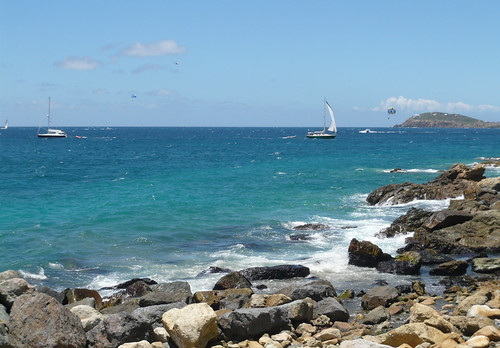
Photo: utfiero
A enticing blend of normal American life with a jaw-dropping setting leads many to choosing a St. Thomas vacation. This Caribbean island is one of the most popular summer vacation destinations in the world. Explore corals and gorgonian forest of sea fans and sea whips. Dive around caves, explore sunken boat wrecks or take a night dive and explore the fantastic world of nocturnal marine life. If you are interested in vacationing in St. Thomas, you may be wondering what fun and exciting activities await you.
You will likely find an unlined number of activities that will peak your internets. If you are looking for something that is exotic and educational all at the same time, you may want to consider scuba diving in St. Thomas. Swim among turtles, bright parrotfish, blue tangs, schools of fry and so much more. Due to its clear waters, corral reefs, and amazing sea life, St. Thomas is one of the best places in the world to go on a scuba diving adventure.
St. Thomas is well-known for its seclusion and beautiful beaches, but scuba diving is a popular underwater activity that brings in tourists from all around the world. If you are interested in scuba diving in St. Thomas, but you have never been before, you do not have to worry.
Photo: travelwizard.com
Scuba diving lessons are obtainable for individuals who want to scuba dive, but do not know how to. After a couple of lessons, you could easily be able to enjoying diving in the clear waters. Whether you consider yourself an experienced scuba diver or just a beginner, you are encouraged to scuba dive while on a guided tour. Scuba diving tours are given by trained and experienced professionals.
In addition to knowing where to look for the best underwater treasures, you will be safe. There are too many accidents that can happen in the open waters. That is why it is advised that you travel with an experienced diver and never go diving by yourself. Since it is advised that you go scuba diving with a trained professional, you will have to find a scuba diving guide or a company that offers tours.
In St. Thomas there are a number of places. When searching for scuba diving guides, you are encouraged to examine the type of tours that are available. You may find scuba diving tours right off the coast or tours that are hosted off of a boat. While searching for scuba diving tours in St. Thomas, it is likely that you will come across the Blue Island Divers. Blue Island Divers is one the most well-known and most recommended scuba diving groups in the St. Thomas area.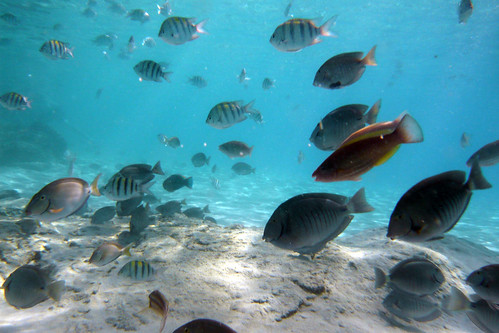
Photo: utfiero
In addition to providing their services to adults, scuba diving lessons and assistance can be given to children. Blue Island Divers offer dives that are focused on underwater wreckage and coral reefs. In addition to Blue Island Divers, it is likely that you may come across a company known as Admiralty Dive Center. The Admiralty Dive Center is a state of the art facility that offers a large number of scuba diving tours. These tours often involve exploring underwater wreckage and underwater sea life.
The best conditions for diving in the islands are found during the summer and fall months, with visibility generally between 60 and 100 feet. Some sites, particularly in Pillsbury Sound, can be explored all year round as they are protected from the wind and rough seas that can affect other more open sites during the winter months. St. Thomas and St. John are close enough to each other that they share many of the same dive sites in the Pillsbury Sound area including Carval Rock, Congo Cay, Grass Cay, Mounds at Mingo, Arches and Tunnels of Thatch and Lovango Cay.
As with the Blue Island Divers, scuba diving lessons and tours are available for individuals of all ages. As previously mentioned, there are a number of scuba diving tours that may be ideal for your next family vacation or romantic getaway. You can easily search for additional scuba diving tours by requesting a vacation brochure from the St. Thomas Island. Additional information may also be obtained through your local travel agent.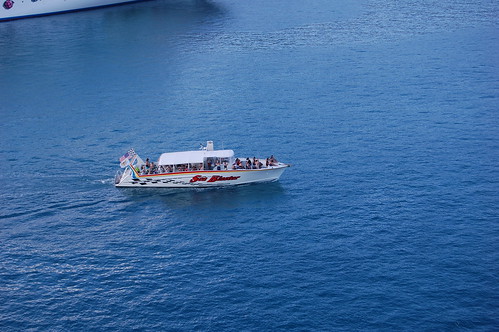
Photo: docpaula54
There are more than 40 moored dive sites around St. Thomas. Most are shallow dives and many only 15 to 20 minutes away from the shore/dock. Popular dive sites include Witchoal II, Navy Barges, Cow & Calf, Frenchman’s Cap, Ledges of Little St. James, Cartanza Senora and Buck Island Cove.
Sources: destination360.com, vinow.com
Saturday, July 11, 2009
Diving Trip in St. Thomas island
Wednesday, July 1, 2009
The Family of Seahorses and Pipefish
Did you have seen a Seahorse swimming away from you when you're diving near them? It so cute animal that I really likes. Seahorses are any species belonging to the genus Hippocampus, which, in turn, belongs to the family Syngnathidae, which also includes pipefish and leafy sea dragons. There are over 47 species of seahorse, mainly found in shallow tropical and temperate waters throughout the world. They prefer to live in sheltered areas such as sea grass beds, coral reefs, or mangroves.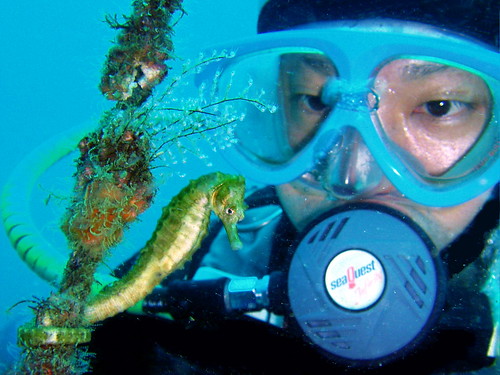
Photo: Nemo
Three different species of seahorse live in the Mediterranean Sea:
- Hippocampus hippocampus (long snout)
- Hippocampus brevirostris (short snout)
- Hippocampus fuscus (immigrated from the Red Sea)
Pipefish look like straight-bodied seahorses with tiny mouths. The name is derived from the peculiar form of their snout, which is like a long tube, ending in narrow and small mouth which opens upwards and is toothless. The body and tail are long, thin, and snake-like. They have a highly modified skeleton formed into armored plating. This dermal skeleton has several longitudinal ridges, so that a vertical section through the body looks angular, not round or oval as in the majority of other fishes.
Many Pipefish are very weak swimmers in open water, moving slowly by means of rapid movements of the dorsal fin. Some species of pipefish have tails that are prehensile as in seahorses. The majority of pipefishes have some form of a caudal fin which unlike seahorses, that can be used for locomotion.
Photo: getahugetank.com
These fish form territories, with males staying in about one square meter of their habitat while females range about one hundred times that area. They bob around in sea grass meadows, mangrove stands, and coral reefs where they are camouflaged by murky brown and grey patterns that blend into the sea grass backgrounds. During social moments or in unusual surroundings, seahorses turn bright colors.
Seahorses are rather inept swimmers and can easily die of exhaustion when caught in storm-roiled seas. They propel themselves by using a small fin on their back that flutters up to 35 times per second. Even smaller pectoral fins located near the back of the head are used for steering.
They anchor themselves with their prehensile tails to sea grasses and corals, using their elongated snouts to suck in plankton and small crustaceans that drift by. Voracious eaters, they graze continually and can consume 3,000 or more brine shrimp per day.
Photo: animals.nationalgeographic.com
Seahorses are so named for their equine profile. Although they are bony fish, they do not have scales, rather a thin skin stretched over a series of bony plates arranged in rings throughout their body. Each species has a distinct number of rings.
Seahorses swim upright, another characteristic that is not shared by their close pipefish relatives, which swim horizontally. Seahorses have a coronet on their head, which is distinct to each seahorse, much like a human fingerprint. They swim very poorly by using a dorsal fin, which they rapidly flutter to propel them, and pectoral fins, located behind their eyes, which they use to steer.
Seahorses have no caudal fin. As they are poor swimmers, they are most likely to be found resting in beds of sea grass or coral reefs, with their prehensile tails wound around a stationary object. They have long snouts, which they use to suck up food, and eyes that can move independently of each other, much like a chameleon. Seahorses eat small shrimp, tiny fish and plankton.
Photo: Felicia McCaulley
Seahorses typically mate for life. The male seahorse is equipped with a brood pouch on the ventral, or front-facing, side. When mating, the female seahorse deposits the eggs in the male's pouch, which the male then internally fertilizes. The male carries the eggs until they emerge, expelling fully-developed, miniature seahorses in the water.
Source: wikipedia.org, animals.nationalgeographic.com.
Tuesday, June 9, 2009
Northern Red Sea - Underground Garden of Eden
The Northern Red Sea is surrounded by the world’s largest expanses of sand. It region of Eritrea is one of the country's six regions, lies along the northern three quarters of the Red Sea, and includes the Dahlak Archipelago and the coastal city of Massawa.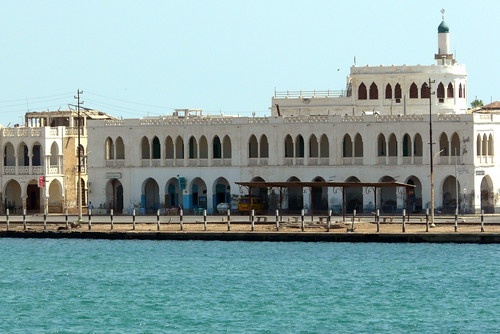
Photo: livetowander
The region borders the Anseba, Central and Southern regions to the west, and the Southern Red Sea region to the east. It has an area of around 27,800 km². The lowest point in Eritrea, Lake Kulul, is in this region.
The Red Sea is considered to be 1 of the 7 Wonders of the underwater world. This forms the basis of a marine eco-system which includes 1,100 species of fish, of which about 10% are endemic, the largest number of fish species in proportion to any other body of water in the world.
The Northern Red Sea has some of the richest coral in the world. In 1980, Dr. Clark wanted to make the Red Sea and its island a National Park. Ras Muhammad has sometimes called it an underwater “Garden of Eden.” The sun makes the Northern Red Sea turn different colors such as red, yellow, orange, and light green.
Photo: nationalgeographic.com
An amazing fish that lives on the in the water is the bright-red lionfish, it has a venomous dorsal spines, these fish usually swim near the bottom of the sea. They wait and trap fish in nooks and crannies.
Another creature that lives in the water is a beast they call “George” he is a Sea Monster, his head is in the shape of a beanbag chair. A humped head wrasse, he has cow lips, chameleon eyes and a body pattern in the form of an intricate green maze on a blue back round. In the red Sea there are over 1000 different kinds of tropical fish and 400 different types of coral. 30 million years ago the Red Sea was closed at its southern end and open on its northern end, it opened up into the Mediterranean Sea allowing Atlantic species to enter and breed there. About 10 million years later the earth shifted and closed the northern end and opened up the southern end. The Red Sea has fish and animals from both the Atlantic and Pacific Ocean.
The Red Sea is a fine choice for diving any time of year but the water temperatures do vary significantly. From June to August the water can reach 28°C but it falls to a chilly 20°C in February. Do plan to bring an appropriate exposure suit to suit the time of year. Therefore, you could find yourself on a coral garden atop a summit and the next a sheer wall could plunge thousands of feet into dark ocean depths. The Red Sea's abundance of marine life and depths of the reef are a thrill that many divers will tell you is unbeatable.
Sources: library.thinkquest.org, wikipedia.org, dive-the-world.com
Monday, June 1, 2009
Sea Star - The Wonderful Animal Underwater
Sea stars or "starfish" are not fish. They exhibit a superficially radial symmetry; typically have five "arms" which radiate from a central disk. However, the evolutionary ancestors of echinoderms are believed to have had bilateral symmetry. There are some 2,000 species of sea star living in all the world’s oceans, from tropical habitats to the cold seafloor.
Photo: NationalGeographic.com
Sea stars belong to a group of animals called echinoderms, which means "spiny skin." They are related to brittle stars, sea urchins, sea cucumbers, and sand dollars. Sea stars have five arms, or rays, connected to a small round body.
Sea stars detect light with five purple eyespots at the end of each arm. Beyond their distinctive shape, sea stars are famous for their ability to regenerate limbs, and in some cases, entire bodies. They accomplish this by housing most or all of their vital organs in their arms. Some require the central body to be intact to regenerate, but a few species can grow an entirely new sea star just from a portion of a severed limb. The bright orange dot in the center of the body is called the madreporite. This organ pumps water into the sea star's body. This pumping action creates suction at the end of hundreds of tube feet, located in paired rows on the underside of the arms. They do exhibit some superficial remnant of this body structure, evident in their larval pluteus forms.
They wrap their bodies around quahogs and other bivalves, using the suction from their tube feet to pull shells apart. When the prey is opened, the sea star pushes its stomach out of its body and into the bivalve, secreting enzymes that digest the prey's soft body tissues. The liquefied bivalve is then absorbed into the stomach. Sea stars feed often, and their size depends on the amount of food they eat, not on their age.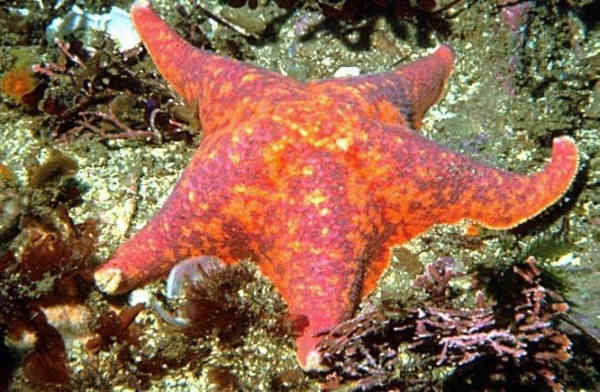
Photo: msnucleus.org
Sea stars do not rely on a jointed, movable skeleton for support and locomotion, but instead possess a hydraulic water vascular system that aids in locomotion. The water vascular system has many projections called tube feet on the ventral face of the sea star's arms which function in locomotion and aid with feeding. Sea stars usually hunt for shelled animals such as oysters and clams. They have two stomachs. One stomach is used for digestion, and the second stomach can be extended outward to engulf and digest prey. This feature allows the sea star to hunt prey that is much larger than its mouth would otherwise allow. Sea stars are able to regenerate lost arms.
A new sea star may be regenerated from a single arm attached to a portion of the central disk. Sea stars are eaten by bottom-dwelling fish and crabs, as well as by sea gulls when low tides leave the sea stars exposed. Regeneration will occur as long as one fifth of the sea star's body remains intact. Sea stars breed in the spring, producing as many as 2,500,000 eggs. Females will feel plump and spongy when their arms are filled with eggs.
Sea star digestion is carried out in two stomachs in the mouth: the cardiac stomach and the pyloric stomach. The cardiac stomach is a sack like stomach located at the center of the body and may be everted out of the organism's body to engulf and digest food. Some species are able to use their water vascular systems to force open the shells of bivalve mollusks such as clams and mussels by injecting their stomachs into the shells.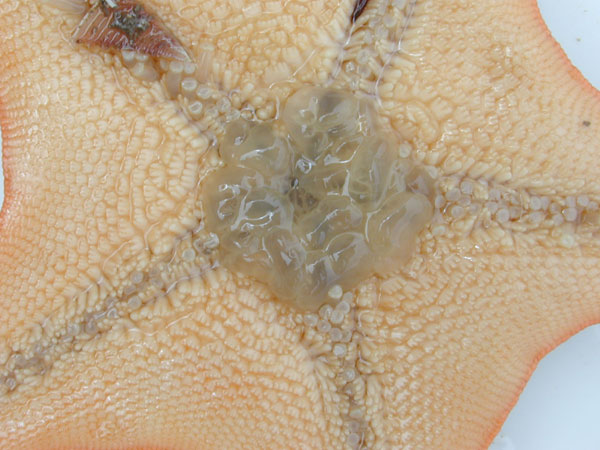
Photo: marinebio.net
With the stomach inserted inside the shell, the sea star is able to digest the mollusk in place. Most sea stars also have the remarkable ability to consume prey outside their bodies. Using tiny, suction-cupped tube feet, they pry open clams or oysters, and their sack-like cardiac stomach emerges from their mouth and oozes inside the shell. The stomach then envelops the prey to digest it, and finally withdraws back into the body.
Sources: edc.uri.edu, nationalgeographic.com, wikipedia.org