Te Deep sea vents are hydrothermal fissures which are present under the sea waters on ocean beds. Hydrothermal vents are locally very common because the earth is both geologically active and has large amounts of water on its surface and within its crust. Common land types include hot springs, fumaroles and geysers. The most famous hydrothermal vent system on land is probably within Yellowstone National Park in the United States. Under the sea, hydrothermal vents may form features called black smokers.
Photo: ocean-ridge.ldeo.columbia.edu
The most famous deep sea vents are probably the ones which are present in the Yellowstone National Park. These vents throw out superheated saline water which is not even suitable for any life forms. Also, these vents are located at depths where sunlight does not reach so the ecosystem that exists here is surviving completely without any sunlight. Bacteria are formed here which form the food of the slightly bigger organisms. Blind crabs and shrimps also exist at such levels.
Scientists first discovered undersea hot springs, known as hydrothermal vents, nearly 30 years ago. These vents, which are among the world's most extreme ecosystems, are found along the ocean ridge, 40,000 miles of underwater mountain range that zig-zags throughout the world's ocean basin. The vents spew super-hot, mineral-rich water that helps support exotic communities of animals and microbes. Issues surrounding research practices in vent areas have been sporadically discussed in the scientific literature since the late 1990s. Now, hydrothermal vents and the habitat they create are in the scientific, public, and political limelight as a result of improved technology that allows for greater studies of these remote areas.
The Mineral exploration companies, driven by the elevated price activity in the base metals sector during the mid 2000s, have turned their attention to extraction of mineral resources from hydrothermal fields on the seafloor. Significant cost reductions are, in theory, possible. Consider that in the case of the Mt Isa orebody, large amounts of capital are required to sink shafts and associated underground infrastructure, then laboriously drill and blast the ore, crush and process it, to win out the base metals, an activity which requires a large workforce.
Photo: science.psu.edu
A hydrothermal field, consisting of chimmneys and compacted chimmney remains, can be reached from the surface via a dynamically positioned ship, using conventional pipe, mined using modified soft rock mining technology, brought to the surface via the pipe, concentrated and dewatered then shipped directly to a smelter.
Deep sea vents are also known as deepwater seeps, deep-sea springs, and hydro-thermal vents. Found at the bottom of the ocean, they are created by volcanic and tectonic activity in areas where huge hostile plates are converging or spreading apart. Magma erupts along the margins of these plates, usually slowly, but sometimes with such ferocity that it creates instant lava lakes. The thick black smoke is actually a plume of metal-rich, superheated water billowing out of the silt- and sediment-covered, gray-and-black chimney-an underwater volcano.
Saturday, January 10, 2009
Deep sea vents
Wednesday, January 7, 2009
Snorkeling at the surface for beginer
Snorkeling is the practice of swimming with a diving mask. Before get down to underwater. Just learn to Snorkeling on the surface with diving mask and fins. It is a popular recreational activity, particularly at tropical resort destinations and at shallow scuba diving locations. Snorkeling is also employed by scuba divers when near the surface, and search and rescue teams may snorkel as part of a water-based search. The primary attraction of snorkeling is the opportunity to observe underwater life in a natural setting.
Photo: tahiti.pictures-pacific.com
You can snorkeling with no special training, only the ability to swim and to breathe through the snorkel. However, for safety reasons, instruction and orientation from a tour guide, dive shop, or equipment rental shop is recommended. Instruction generally covers equipment usage, basic safety, what to look for, and what to look out for, and conservation instructions. It is secured in place by two straps, one around the waist and another behind the user and between the legs.
The mask and snorkel are similar to those used in scuba diving, but since they are not subjected to the pressures of deep water, they can be more lightweight and comfortable. Swimfins used in snorkeling are usually longer than those used in diving. Most important for Snorkeling is swimmers snorkel, It is a tube about thirty centimeters long, usually J-shaped, fitted with a mouthpiece, and constructed of rubber or plastic. It is used for breathing air from above the water surface when the mouth and nose are submerged, either when snorkeling or during a surface swim before or after scuba diving.
The snorkel usually has a piece of rubber that attaches the snorkel to the outside of the strap of the diving mask, as sticking the snorkel in between the strap and the mask could cause the mask to leak, or risk losing the snorkel should the diver choose to switch to scuba. Snorkeler underwater, with snorkel's sump valve apparent in foreground.
The most common type of snorkel is a simple tube that is allowed to flood when underwater. The snorkeller expels water from the snorkel either with a sharp exhalation on return to the surface or by tilting the head backwards once the head is above water. Some modern snorkels have a sump in the mouthpiece to allow a small volume of water to remain in the snorkel without being inhaled when the snorkeler breathes. Some also have a one-way output valve in the sump, which automatically drains the sump as it fills with water. Some snorkels have float-operated valves attached to the surface end of the tube to keep water out when the snorkeller submerges. The more modern and quality snorkels have a one way valve on the top end that forces any water that splashes over the top to slide out of the sides, keeping the user's mouth free from water.
A longer tube would place the lungs in deeper water where the surrounding water pressure is higher and the lungs would be unable to inflate when the diver inhales, because the muscles that expand the lungs are not strong enough to operate against the higher pressure. Experienced snorkelers often start to investigate amateur free-diving, which should be preceded by at least some training from a dive instructor or experienced free-diver. By the way, if you like to explore deeper in underwater, you would be to scuba driving.
Sunday, January 4, 2009
Natural wonder at Galapagos Islands
The Galapagos Islands consists of 6 main islands 12 smaller islands and over 40 islets. The Galápagos are a ‘melting pot’ of marine species. Ongoing seismic and volcanic activity reflects the processes that formed the islands. These processes, together with the extreme isolation of the islands, led to the development of unusual animal life. Many people come from all over to see the turtles, whale sharks, hammerheads, colorful fish and other underwater marvels. Taking a land tour to see the islands themselves is a bonus that most divers enjoy as well.
Diving in the Galapagos Islands
By Enid Glasgow
The Galapagos Islands are known for many things. The same natural wonders that made the Galapagos such an interesting place to study by pioneers like Darwin have also made it an interesting place to vacation. Outdoor enthusiasts from all corners of the world who are traveling on a variety of different budgets make the trek to these islands every year. Whether they find interest in the unique bird populations on land or the one-of-a-kind underwater environment, these travelers share in common a true interest in adventure travel.
Photo: galapagosconnection.com
For underwater adventurists, the Galapagos Islands provide a unique experience. Thriving reefs, marine life and some of the best underwater visibility (often 100 feet or more) on the planet help to give the Galapagos Islands a reputation as one of the seven underwater wonders of the world. This is partially due to the fact that around 70,000 square kilometers of Galapagos marine areas are considered to be protected and the islands are far enough out of the way to make the destruction of this environment less likely.
What you can expect from a Galapagos diving Trip
To begin with, the Galapagos Islands offer something for divers of all skill levels. That being said, the water conditions of many dive areas are much more appropriate for intermediate and advanced divers. For any diver, the Galapagos is sure to deliver a life changing experience.
Photo: rphs.devisland.net
Currents - Due to strong currents, most dives done in the Galapagos are drift dives. Throughout different seasons, the Humboldt and Panama currents affect dive conditions. Divers not experienced in drift diving may want to steer clear of the dives offered in current-heavy areas.
Water Depth - While there are plenty of dives which take place shallower water, many of the most impressive dive experiences are to be had at deeper depths around 70-100 feet and beyond.
Temperature - Thermoclines play a big role in diving in the Galapagos. Surface temperatures reach between 18 and 30 degrees Celsius throughout the year. These temperatures can fluctuate as much as 5 degrees Celsius as you descend.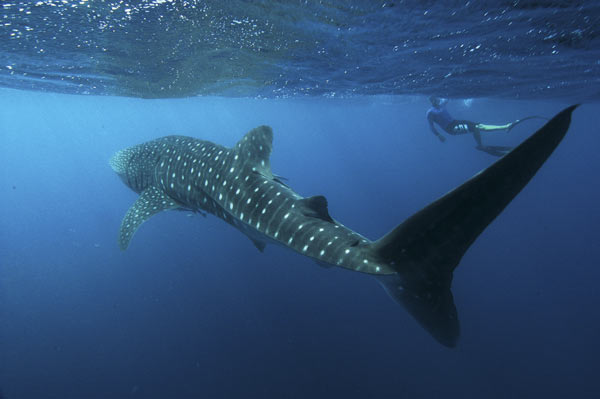
Photo: elasmodiver.com
Marine Life - Expect to see abundant marine life on any dive in Galapagos. As this area has been protected from hunting for quite some time, various marine specie populations have grown tremendously. Sharks, rays, sea lions, whales, reef fish and much more are not uncommon sites. In fact, rare whale sharks are seen fairly regularly in some dive zones.
Safety
Travelling with an experience dive company is important. It's also important to make your level of dive experience clear to your dive guides. Many dive charters do provide on-board safety equipment so you should ask about that as well. Lastly, since 2001, a hyperbaric chamber has been available in the Galapagos in case of emergencies.
Photo: galapagosyachts.com
Whether you trek to the Galapagos on a live aboard dive charter or enjoy a luxury cruise through the islands, take at least a couple days to explore everything the Galapagos have to offer, under the surface. A dive opportunity like you'll find in the Galapagos would be a shame to miss and an experience to remember.
Enid Glasgow is a travel writer who enjoys traveling to remote destinations. She enjoys traveling with Big Five Tours, providers of Galapagos cruises and luxury travel tours.
Galapagos Inn Hotel, Buzios
Photo: chimuadventures.com
To discover most of Buzios with ease, guests can use Galapagos Inn Hotel as their home base. Every room is equipped with the home comforts you would expect from a hotel of this class. The combination of Buzios's rich culture with modern conveniences and superb service makes this hotel stand out. For your reservation at the Galapagos Inn Hotel Buzios, simply select your dates and fill in our secure online booking form.
Thursday, January 1, 2009
Underwater photography
Most people who use to dive in underwater would like to take a photo about fishes or plants that at underwater sea. So, if you want to do. it would be use by Underwater camera for use under water as well. Therefore, you must know to take its by Underwater photography.
Photo: cameldive.com
Underwater photography is the process of taking photographs while under water. It is usually done while scuba diving, but can be done while snorkeling or swimming. Underwater imaging is considered an especially challenging area of photography, since it requires very specialized equipment and techniques to be successful.
Despite these challenges, it offers the possibility of many exciting and rare photographic opportunities. Animals such as fish and marine mammals are the most common subjects, but photographers also pursue shipwrecks, submerged cave systems, underwater "landscapes", and portraits of fellow divers.
The primary obstacle faced by underwater photographers is the extreme loss of color and contrast when submerged to any significant depth. The longer wavelengths of sunlight are absorbed quickly by the surrounding water, so even to the naked eye everything appears blue-green in color. The loss of color not only increases vertically through the water column, but also horizontally, so subjects further away from the camera will also appear colorless and indistinct. This effect is true even in apparently clear water, such as that found around tropical coral reefs.